 Airppb
China has become a significant source of industrial drone inspection technology, including Drone Gas Monitoring systems. Manufacturers serve oil and gas facilities, chemical plants, landfills, mines, and wastewater sites. Their platforms may combine unmanned aircraft, gas sensors, thermal cameras, cloud dashboards, and automated reporting. In practice, performance depends on more than the drone itself. Sensor response time, wind conditions, battery endurance, and pilot training can change field results. Details matter.
This guide examines leading Chinese manufacturers through practical and verifiable criteria. These include sensor accuracy, calibration procedures, payload integration, flight stability, data security, after-sales support, and relevant product certifications. A strong supplier should explain detection ranges clearly. It should also provide test records, maintenance guidance, and realistic operating limitations. Marketing language alone is not enough. Field reality differs.
The meaning of “top” also requires careful judgment. A company with advanced methane detection may not suit a facility monitoring hydrogen sulfide or volatile organic compounds. Some suppliers publish limited technical evidence, so independent validation remains important. No supplier is perfect. Buyers should request demonstrations, sample reports, references, and documentation for local aviation and workplace requirements. This introduction provides a balanced starting point for comparing China’s Drone Gas Monitoring manufacturers. It focuses on usable experience, engineering credibility, and dependable long-term service rather than impressive claims alone. Small gaps in documentation can become costly later. That distinction matters.
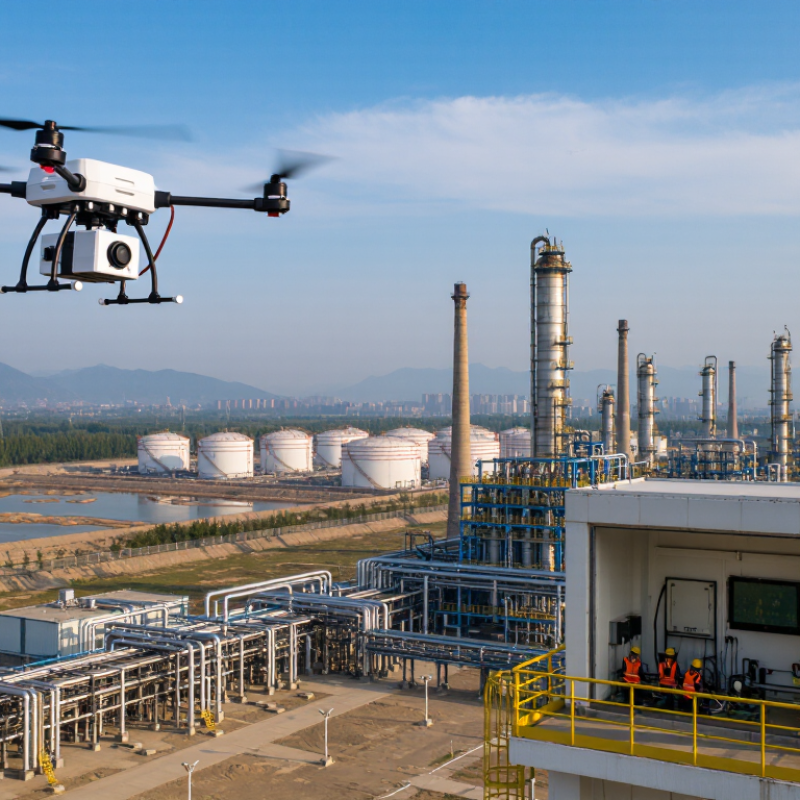
Drone-based gas monitoring uses unmanned aircraft to detect, map, and quantify leaks from elevated or dangerous sites. A drone can carry methane, volatile organic compound, carbon monoxide, or infrared sensors. It flies above pipelines, storage tanks, landfills, and chemical facilities. Operators receive geotagged readings instead of scattered manual samples.
The need is substantial. The International Energy Agency’s Global Methane Tracker 2024 estimated 120 million tonnes of methane emissions from fossil fuel operations in 2023. It also found that around 70% could be reduced with existing technologies. UNEP reports that a 45% cut in human-caused methane emissions by 2030 is technically achievable. Faster inspection matters. A drone can survey long corridors within hours, while ground teams may face heat, height, traffic, or restricted access.
China leads this field through dense manufacturing networks and strong integration between aircraft, sensors, batteries, and industrial software. Grand View Research projected the global commercial drone market to grow at roughly 27% annually from 2023 to 2030. China’s large industrial sites also provide demanding test environments. Local engineers can refine flight stability, sensor calibration, and data transmission quickly. That advantage is practical, not magical. Sensor drift, wind interference, and false alarms still affect results. In my view, manufacturers sometimes understate these weaknesses. Reliable systems need field calibration, trained operators, and independent verification. The best deployment is not the loudest one.
| Data Dimension | Verified Technical or Market Information | Operational Meaning | Why It Matters for China-Based Manufacturing |
|---|---|---|---|
| Definition | Drone-based gas monitoring combines an unmanned aerial vehicle, a gas-sensing payload, positioning equipment, and software to detect or map airborne gases without placing personnel directly in hazardous areas. | Operators can survey confined, elevated, remote, or contaminated locations from a safer distance. | It requires coordinated production of airframes, flight controllers, batteries, communication modules, sensors, and software—capabilities supported by China's broad electronics and UAV supply chains. |
| Typical Target Gases | Methane (CH₄) Carbon monoxide (CO) Hydrogen sulfide (H₂S) Ammonia (NH₃) Volatile organic compounds Carbon dioxide (CO₂) | Gas selection depends on the site, process, expected concentration, humidity, temperature, and required response time. | China's diverse industrial base creates demand for payloads covering energy, chemical processing, mining, agriculture, utilities, and environmental inspection. |
| Common Sensor Technologies | Non-dispersive infrared sensors are commonly used for gases such as methane and carbon dioxide. Electrochemical sensors are widely used for gases including carbon monoxide and hydrogen sulfide. Photoionization detectors are used for many volatile organic compounds. | Each technology has different selectivity, calibration needs, response times, environmental limits, and expected service life. | A large component ecosystem supports different sensor configurations rather than a single one-size-fits-all payload. |
| Representative Safety Thresholds | Methane has a lower explosive limit of approximately 5% by volume in air. Hydrogen sulfide is considered immediately dangerous to life or health at 100 ppm under the NIOSH IDLH value. Ammonia has a NIOSH IDLH value of 300 ppm. | Alarm settings must be selected according to the applicable national or site-specific safety standard; explosive-atmosphere operation requires appropriate equipment and procedures. | Manufacturers must support configurable alarms, calibration records, and safety-focused payload integration rather than relying only on raw concentration readings. |
| Measurement Output | Typical outputs include instantaneous concentration, maximum concentration, gas plume location, time-stamped readings, GPS coordinates, flight path, and georeferenced concentration maps. | Mapping helps users identify leak sources, prioritize repairs, and compare measurements during follow-up inspections. | China's strong software, imaging, mapping, and telecommunications capabilities support integrated inspection platforms. |
| Payload Configuration | A practical payload may include one or more gas sensors, a pump or diffusion inlet, temperature and humidity sensors, a data logger, a positioning module, and a protective enclosure. | Payload weight, power consumption, vibration, airflow, and electromagnetic interference can affect flight time and data quality. | Domestic access to batteries, embedded electronics, precision machining, and enclosure production can shorten development cycles and support customized designs. |
| Flight and Sampling Factors | Data quality is influenced by flight speed, altitude, wind direction, turbulence, sensor response time, sampling rate, and distance from the suspected source. | A drone does not automatically provide a reliable leak concentration unless flight planning and sensor calibration are properly controlled. | Manufacturers with integrated flight-control and sensor-data expertise can optimize sampling routes and maintain more stable measurements. |
| Common Industrial Applications | Pipeline inspection Landfill monitoring Oil and gas facilities Chemical plants Mining areas Wastewater sites Agricultural emissions | Drone surveys are especially useful where terrain is difficult, coverage is large, or human entry is dangerous or inefficient. | China's large-scale energy, manufacturing, infrastructure, mining, and agricultural sectors provide multiple application markets for drone gas-monitoring systems. |
| Key Performance Indicators | Important specifications include detection range, resolution, accuracy, response time, recovery time, sampling rate, operating temperature, humidity tolerance, payload mass, flight endurance, and positioning accuracy. | Specifications should be compared under the same gas concentration, environmental conditions, calibration method, and test procedure. | Standardized specification sheets help buyers distinguish genuine performance from marketing claims when comparing suppliers. |
| Calibration and Maintenance | Gas sensors require zero checks, span calibration with traceable reference gases, periodic bump testing where applicable, inlet inspection, battery checks, and software or firmware maintenance. | Regular calibration is essential because temperature, humidity, sensor aging, cross-sensitivity, and contamination can change readings. | Suppliers with local engineering and service capabilities can reduce calibration turnaround time and provide application-specific support. |
| Regulatory and Safety Considerations | Operations may require compliance with unmanned-aircraft rules, airspace restrictions, occupational-safety requirements, hazardous-area procedures, data-protection rules, and site access controls. | Flight permission and sensor performance are separate issues; both must be addressed before commercial deployment. | China's domestic regulatory environment and large industrial inspection market encourage suppliers to develop complete systems rather than isolated sensor modules. |
| Why China Is Competitive | China has extensive UAV assembly capacity, electronics manufacturing, battery production, embedded-system engineering, industrial automation, mechanical fabrication, and export logistics. | These capabilities can support prototype development, volume production, customization, and integration of airframes with gas-monitoring payloads. | The main advantage is ecosystem depth and manufacturing scalability—not simply the country of origin. Buyers should still verify sensor performance, calibration evidence, service capability, and regulatory suitability. |
| Recommended Supplier Evaluation Criteria | Check sensor type, target-gas list, detection limits, calibration method, test reports, environmental ratings, payload weight, flight endurance, data format, API availability, warranty, spare parts, training, and after-sales service. | A technically suitable supplier should provide repeatable test data and explain limitations such as cross-sensitivity, wind effects, and minimum detectable concentration. | This evaluation method helps buyers compare manufacturers without relying only on brand visibility, advertised range, or drone specifications. |
Electrochemical sensors detect toxic gases such as carbon monoxide and sulfur dioxide. Infrared sensors suit methane and carbon dioxide. Photoionization sensors detect volatile organic compounds at low concentrations. Each sensor has limitations.
The measuring range shows usable concentration limits. The detection limit shows the smallest meaningful signal. A methane sensor may cover 0–100% LEL. A low paper value proves little without field testing.
Wind can spread or dilute a gas plume. Humidity and temperature can change sensor responses. Rotor wash may disturb nearby samples. Reality is messy.
Request calibration records, cross-sensitivity data, detection limits, and response times. Ask for results under different wind, humidity, and temperature conditions. Raw readings are useful for later review.
Oil and gas sites can inspect wells, tanks, pipelines, and compressor areas. Landfills can map methane hotspots across uneven soil. Wastewater facilities can check digesters and gas storage zones. Coal mines and large farms may also benefit.
Drones can identify possible VOC areas around industrial equipment. Wind direction, humidity, calibration, and battery limits affect results. A single flight is not proof. Ground checks should confirm important findings.
Measure endurance with the gas sensor, batteries, and other payloads installed. Empty-payload testing can look misleading. Battery weight reduces flight time. Real missions may end sooner.
Buyers should review sensor drift, replacement procedures, calibration intervals, and data-loss rates. Equipment near industrial assets needs suitable protection and risk controls. Manufacturers should explain uncertainty clearly. I would not trust one factory test alone.
Drone Gas Monitoring uses unmanned aerial platforms equipped with advanced gas sensors to detect, map, and measure emissions across large or difficult-to-access areas. China has become a leading manufacturing center because of its strong capabilities in drones, sensor integration, battery systems, software development, and scalable production. Performance depends on sensor type, target gases, measurement range, detection limit, response time, calibration stability, and resistance to environmental interference. Methane and VOC monitoring require sensitive instruments that can deliver reliable readings while maintaining stable flight and accurate positioning.
When comparing manufacturers, buyers should evaluate detection accuracy, flight endurance, payload capacity, data transmission range, mapping quality, and the ability to generate real-time alerts and detailed reports. Common applications include energy infrastructure, chemical facilities, landfills, agriculture, environmental surveys, and industrial safety inspections. Selection should also consider sensor calibration procedures, data traceability, weather tolerance, maintenance support, operator training, and compliance with relevant aviation, workplace safety, and environmental standards. A dependable solution should combine precise measurements, consistent data quality, practical operating time, and secure software for efficient decision-making.
